Solar Panel Installer Widnes, an independent guide / The grid
Batteries and the grid
A battery changes three things about a solar system: how much of the output you use yourself, how the system is connected, and how much an export limit costs. The second is the one quotes most often leave out.
Sources checked on 3 November 2026. Written by SEO Dons, which sells and fits nothing.
Two ways to add a battery
| Hybrid inverter (shared) | Battery with its own inverter | |
|---|---|---|
| Export total for the connection | The hybrid's rating only | Solar inverter plus battery inverter |
| 3.68 kW solar plus a 3 kW battery | 3.68 kW: notify after | 6.68 kW: apply first |
| Adding to an existing system | Usually means replacing the inverter | Leaves the solar inverter in place |
| Charging from the grid at night | Possible on many models; check the datasheet | Possible on many models; check the datasheet |
Neither is better in itself. A hybrid suits a new system; a separate battery inverter is often simpler when adding storage to panels already on the roof. What matters is that the quote says which route the finished system will take and, if it needs approval, that the timetable allows for it.
Output through the year
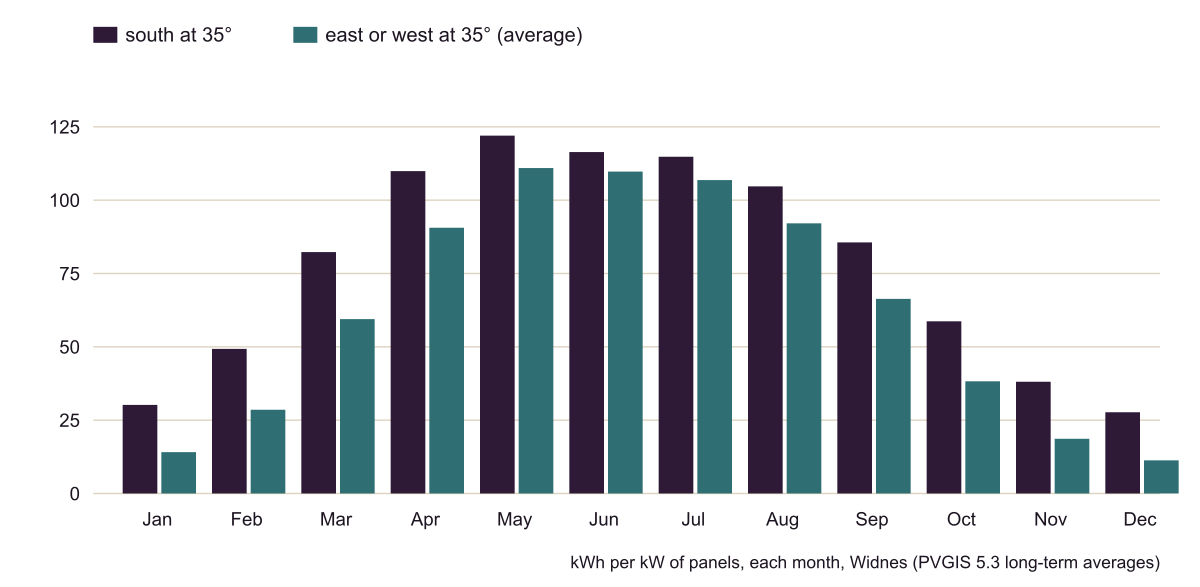
| Month | kWh a day | Month | kWh a day |
|---|---|---|---|
| January | 4.7 | July | 17.9 |
| February | 8.5 | August | 16.3 |
| March | 12.8 | September | 13.8 |
| April | 17.7 | October | 9.2 |
| May | 19.0 | November | 6.1 |
| June | 18.8 | December | 4.3 |
Averages hide the spread: from one day to the next, the weather pushes output well above or below these figures. A battery sized to soak up a summer afternoon will be half-used in spring and autumn and barely touched from November to January, unless it also charges on a cheap overnight tariff.
Matching a battery to Widnes output
A battery only earns its keep on days when the panels make more than the house uses. On average, eleven 440 W south-facing panels in Widnes make at least 10 kWh a day in 7 months of the year and at least 15 kWh a day in 5; in 2 months they average under 5 kWh a day. A 5 kWh battery can fill on many days from spring to autumn. A 10 kWh one needs a bright day and little daytime use to fill outside the long days of late spring and summer, so check how often your own household would use the extra capacity before paying for it.
A worked example: a battery under a 3.68 kW limit
Take fourteen 440 W panels, 6.16 kWp facing south, on a 5 kW hybrid inverter with exports capped at 3.68 kW. If nothing were used at home when output topped the cap, PVGIS hourly figures for Widnes put the energy held back at about 276 kWh a year. Those hours fall around the middle of bright days from spring to early autumn. Because the inverter itself stops at 5 kW, the power above the cap is never more than 1.32 kW, the gap between the two, so a battery that can charge at that rate or faster could take all of it whenever it has room.
Batteries and export limits
Where the network sets an export limit, a battery is the most effective way to keep the output it would otherwise hold back. It charges in the hours when the panels exceed the cap and the house is not using the power, which are exactly the hours a limit bites. On the export limits page the worst-case loss assumes no battery; with one charging through the middle of the day, most of that loss disappears.
Paying for a battery
Batteries are left out of the government's cost figures, so the per-kW averages on prices do not cover them; ask for the battery as its own line on the quote. The Warm Homes Loan Scheme can lend up to £15,000 for a battery, separately from the panels, and the national rules for the Warm Homes: Local Grant have allowed batteries alongside solar from 2 February 2026, though Halton's page does not list them. Whether the battery pays its way comes down to how much more of the output you use at home, the sum shown on is it worth it?
Before you buy
- Ask for the usable capacity in kWh, the charge and discharge rate in kW, and the warranty in years and cycles.
- Check the connection route for the system with the battery included.
- Ask where it will go: batteries need a suitable, ventilated place, often a garage or utility room.
- Installed batteries are zero-rated for VAT until 31 March 2027.
Related pages
Sources for this page
- PVGIS 5.3, European Commission Joint Research Centre: long-term yearly output for Widnes by tilt and direction
- PVGIS 5.3 hourly series for Widnes, 2020: the basis for the clipping and export-limit figures
- SP Energy Networks, connections: small generation and how to notify or apply
- DESNZ solar PV cost data, 2025/26: prices per kW by region and size
- DESNZ: Warm Homes Loan Scheme rules, version 3 (September 2026)
- DESNZ: Warm Homes: Local Grant guidance for councils (updated June 2026)
- Halton Borough Council: the Warm Homes: Local Grant page
- HMRC Notice 708/6: VAT on energy-saving materials
Questions about batteries
Does a battery need permission from the network?
It needs to be included in the notification or application. A battery sharing a hybrid inverter adds nothing to the export total; one with its own inverter adds that inverter's rating, which can take a system into the apply-first route.
What size battery suits a Widnes solar system?
It depends on what you use in the evening. Eleven 440 W south-facing panels make about 19 kWh a day on average in June and about 4 in December, so a battery that covers a summer evening will sit near empty for much of the winter.
Can I get help paying for a battery?
The Warm Homes Loan Scheme can lend up to £15,000 for a battery, separately from panels, through approved lenders. The Warm Homes: Local Grant allows batteries alongside solar panels nationally; Halton's page does not list them, so ask when you apply.
A quote, an inverter or a connection question about your Widnes home?
Tell us what you are weighing up, with your Widnes postcode. The message goes to SEO-DONS LTD, which publishes this independent guide, and the answer comes back by email. Asking costs nothing and binds you to nothing.
What happens next
- Send the form; your postcode tells us which part of Widnes the roof is in.
- We read what you sent and reply by email with the figures and sources that apply.
- Whether you go ahead, and with which firm, stays your decision.