Solar Panel Installer Widnes, an independent guide / The grid
Export limits: what a cap really costs
When a larger system is approved, the network can ask for a cap on what the house sends back. The phrase sounds expensive. In Widnes, for the sizes homes usually fit, the worst case is a few per cent of a year's output, and the real figure is lower.
Sources checked on 3 November 2026. Written by SEO Dons, which sells and fits nothing.
How a limit works
A current sensor on the incoming supply tells the inverter how much is flowing out to the grid. If that would rise above the agreed limit, the inverter reduces its output just enough to stay at it. Nothing changes for appliances in the house: they draw what they need, and every watt they use is a watt that is not exported, so it does not count against the limit.
The worst case in Widnes
| Limit as share of panels | South | South-east | East | West |
|---|---|---|---|---|
| 40% | 18.4% | 17.2% | 12.0% | 12.1% |
| 50% | 10.2% | 9.1% | 5.3% | 5.4% |
| 60% | 4.7% | 4.0% | 1.6% | 1.6% |
| 70% | 1.4% | 1.0% | 0.2% | 0.1% |
| 80% | 0.1% | under 0.1% | under 0.1% | under 0.1% |
Our sums from the PVGIS 5.3 hourly series for Widnes, 2020. These figures include any clipping by an inverter of the same size as the limit.
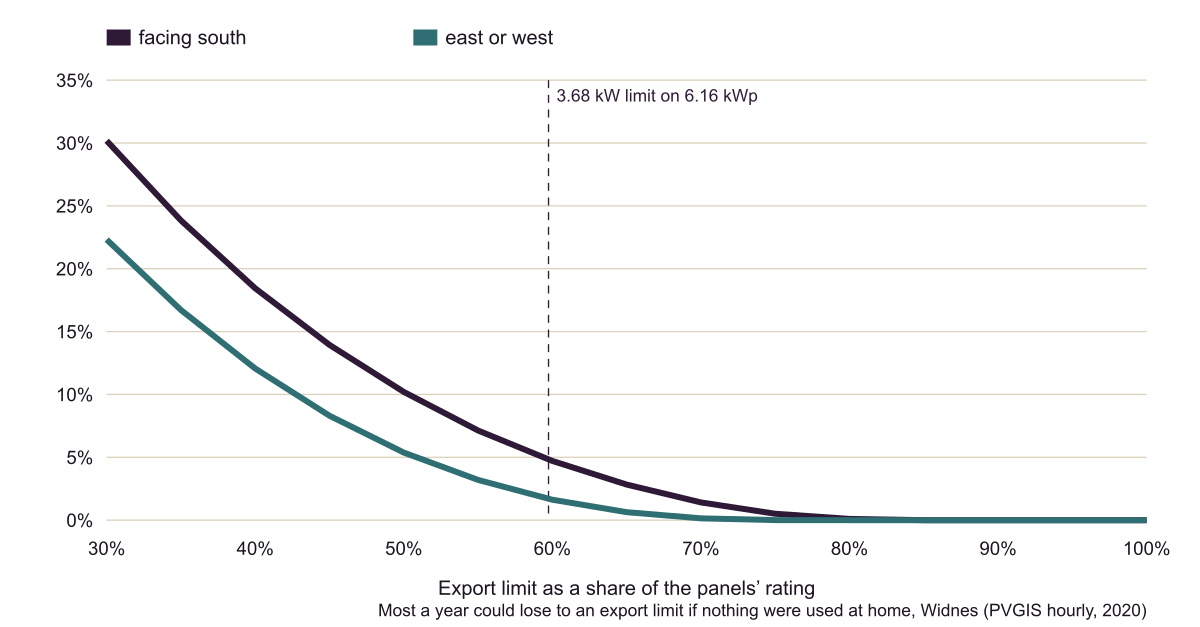
Why the real loss is lower
The table assumes the house uses nothing at all during the brightest hours. Every home uses something: a fridge and freezer, a router, standby loads, and on many days a washing machine or oven. Ofgem's typical figure for a medium home is a few thousand kWh a year, a share of it in daylight. A battery can take several kW at midday, and an immersion diverter sends surplus to the hot-water cylinder. With either, the hours when output tops the limit and nobody is using it shrink sharply.
A worked example
Fourteen 440 W panels, 6.16 kWp facing south, on a 5 kW hybrid inverter with a 3.68 kW export limit. Over a year in Widnes they would make about 5,785 kWh without the limit. Even if nothing were used at home, the limit would hold back about 4.8% of the year's output, leaving about 5,509 kWh; with ordinary use and a battery charging through the middle of the day, the loss would be a fraction of that. The same panels on a 3.68 kW inverter, with no limit, would clip about 4.8% and could not send the surplus anywhere else.
Checking the limit at handover
Before the installer leaves, ask to be shown where the limit is set, in the inverter's settings or its app, the figure it is set to, and where the sensor sits on the incoming cable. Write the figure down with the G99 approval. If the inverter is ever replaced or reset to its factory settings, the limit has to be set again, because the network's approval assumed it; an electrician who changes the inverter later needs to know it was there.
What to ask the installer
- Will the system need a G99 application, and is an export limit expected?
- What limit, and is it set in the inverter or by a separate control unit?
- Does the predicted output on the quote allow for the limit?
- What happens if the sensor fails: does the inverter stop or carry on?
Related pages
Sources for this page
Questions about export limits
What is an export limit on a solar system?
A setting, usually in the inverter with a sensor on the incoming cable, that stops the house sending more than a set amount of power to the grid at any moment. Power used inside the house is not limited.
Will SP Energy Networks make me limit my exports?
Only a larger system that goes through the apply-first route may be given a limit, and only where the local network needs it. Systems on the notify-after route are not limited by the network.
How can I reduce what an export limit wastes?
Use more at home at midday: a battery, an immersion diverter for hot water, or timing the washing machine and dishwasher. Each soaks up output that would otherwise be held back.
A quote, an inverter or a connection question about your Widnes home?
Tell us what you are weighing up, with your Widnes postcode. The message goes to SEO-DONS LTD, which publishes this independent guide, and the answer comes back by email. Asking costs nothing and binds you to nothing.
What happens next
- Send the form; your postcode tells us which part of Widnes the roof is in.
- We read what you sent and reply by email with the figures and sources that apply.
- Whether you go ahead, and with which firm, stays your decision.