Solar Panel Installer Widnes, an independent guide / The grid
Inverter sizing: how small is too small?
Quotes often pair panels rated at 4.8 or 5 kWp with a 3.68 kW inverter. That looks like a mismatch, but it is usually deliberate, and in Widnes the cost in output is smaller than most people expect.
Sources checked on 3 November 2026. Written by SEO Dons, which sells and fits nothing.
What clipping is
The inverter turns the panels' direct current into the alternating current your house uses. It has a maximum output. When the panels could deliver more than that, the inverter holds its output at the maximum and the rest is not collected: on a chart of the day the top of the output curve looks clipped flat. The panels and inverter come to no harm; a little energy is simply not harvested.
How much it costs in Widnes
| Inverter as share of panels | South | South-east | East | West |
|---|---|---|---|---|
| 50% | 10.2% | 9.1% | 5.3% | 5.4% |
| 60% | 4.7% | 4.0% | 1.6% | 1.6% |
| 70% | 1.4% | 1.0% | 0.2% | 0.1% |
| 75% | 0.5% | 0.3% | under 0.1% | under 0.1% |
| 80% | 0.1% | under 0.1% | under 0.1% | under 0.1% |
| 90% | under 0.1% | under 0.1% | under 0.1% | under 0.1% |
| 100% | under 0.1% | under 0.1% | under 0.1% | under 0.1% |
Our sums from the PVGIS 5.3 hourly series for Widnes, 2020, after PVGIS's standard 14% system losses.
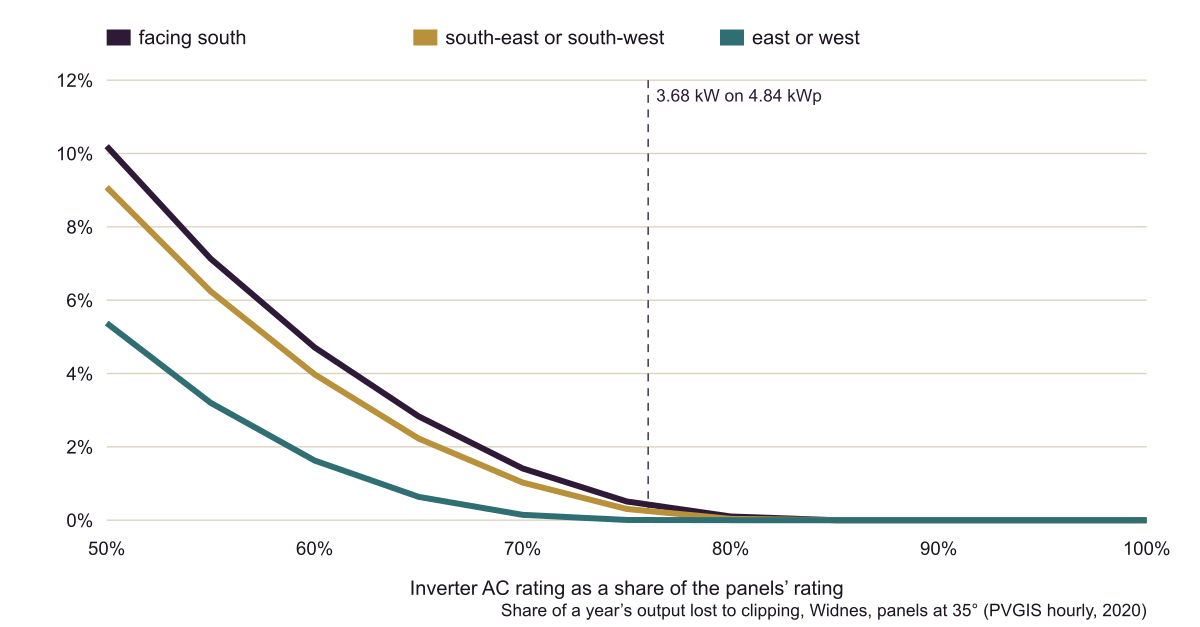
Why east and west roofs clip less
A south roof at 35 degrees faces the midday sun almost square on in summer, so on clear days it gets close to its peak. An east roof catches the morning sun at a slant and loses the light after midday; its output curve is lower and broader. In the 2020 series, east-facing panels never reached 78% of their rating, so an inverter at 75% of the panels on an east roof loses almost nothing. That is one reason east-west systems are often paired with comparatively small inverters.
South-west roofs behave almost exactly like south-east ones in Widnes. With an inverter at 70% of the panels' rating, the hourly figures give 1.0% of a year lost facing south-west and 1.0% facing south-east, about a quarter less than the 1.4% a south roof loses. A house whose main slope faces south-west can therefore pair the same panels with a slightly smaller inverter for the same loss.
Choosing a size
- For the connection route. On a single-phase supply, a solar inverter of 3.68 kW or less, with no separate battery inverter, keeps the system on the notify-after route.
- For the output. On a south roof, keep the inverter at about 75% of the panels or more and clipping stays under 1%; on east or west roofs you can go lower.
- For later. If a battery is likely, a hybrid inverter avoids adding a second inverter, and so avoids pushing the total over the threshold.
- Within the maker's limits. Each inverter has a maximum DC input and voltage range; the panel strings must fit them. See reading an inverter datasheet.
Fourteen 440 W panels, 6.16 kWp, on a 3.68 kW inverter would clip about 4.8% of a year facing south: about 5,509 kWh instead of roughly 5,785 on a 5 kW inverter. Whether that difference is worth an application to the network is a judgement the connection checker helps you make.
Related pages
Sources for this page
- PVGIS 5.3 hourly series for Widnes, 2020: the basis for the clipping and export-limit figures
- PVGIS 5.3, European Commission Joint Research Centre: long-term yearly output for Widnes by tilt and direction
- SP Energy Networks, connections: small generation and how to notify or apply
- MCS MIS 3002 v6.0: the installation standard for solar PV
Questions about inverter size
Should the inverter be the same size as the panels?
It need not be. In Widnes, an inverter at 80% of the panels' rating loses about 0.1% of a year's output on a south-facing roof, and a smaller inverter can keep the system on the notify-after connection route.
What does an oversized panel array mean on a quote?
It means the panels add up to more kW than the inverter. That is common and usually sensible. Ask for the ratio and the expected clipping loss to be stated.
Does a smaller inverter make my system worse in winter?
No. Clipping happens only when the panels are producing near their peak, on bright days from spring to autumn. In winter the panels rarely come close to the inverter's limit.
A quote, an inverter or a connection question about your Widnes home?
Tell us what you are weighing up, with your Widnes postcode. The message goes to SEO-DONS LTD, which publishes this independent guide, and the answer comes back by email. Asking costs nothing and binds you to nothing.
What happens next
- Send the form; your postcode tells us which part of Widnes the roof is in.
- We read what you sent and reply by email with the figures and sources that apply.
- Whether you go ahead, and with which firm, stays your decision.